

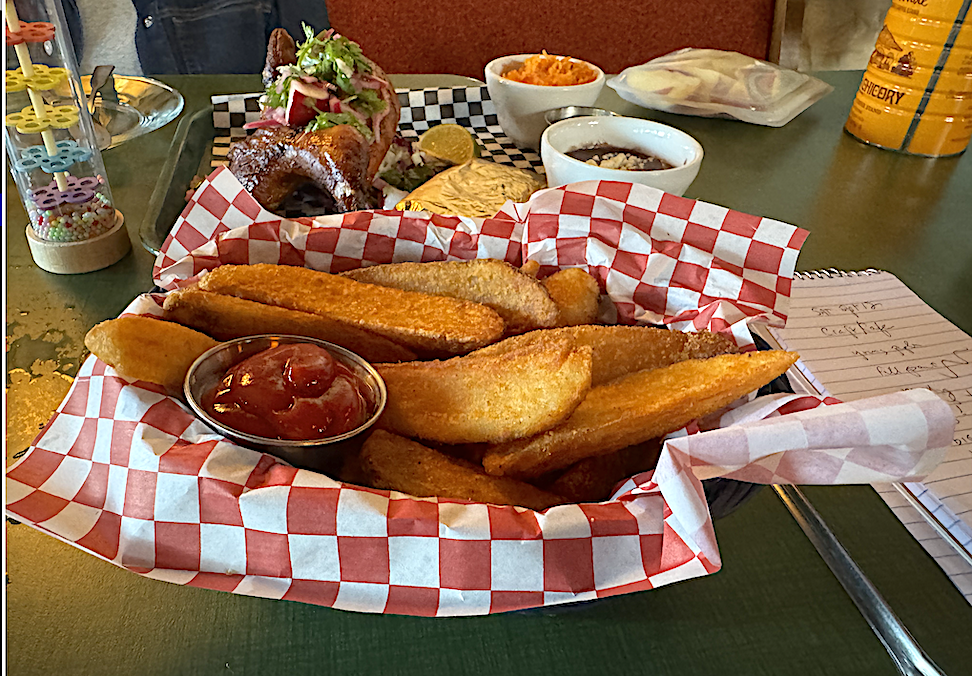
A potato wedge by any other name is just … a jojo. Whut?
I’d never heard of jojos until our recent extended stay in Portland, Oregon. Although the simple dish’s origins are not confirmed, it’s widely held that jojos came into being in Rose City. They’re popular in the Pacific Northwest — we had several places to choose from in Portland — but largely unknown outside that region.
When I travel, I like to pair up dishes from where I’m visiting to similar ones in Tampa Bay. I had little hope for jojos, but Bonnie discovered that Three Birds Tavern in St. Pete has them; Thus, an unlikely FFF was hatched.
Meet our Portland entry.
LAVERNE’S
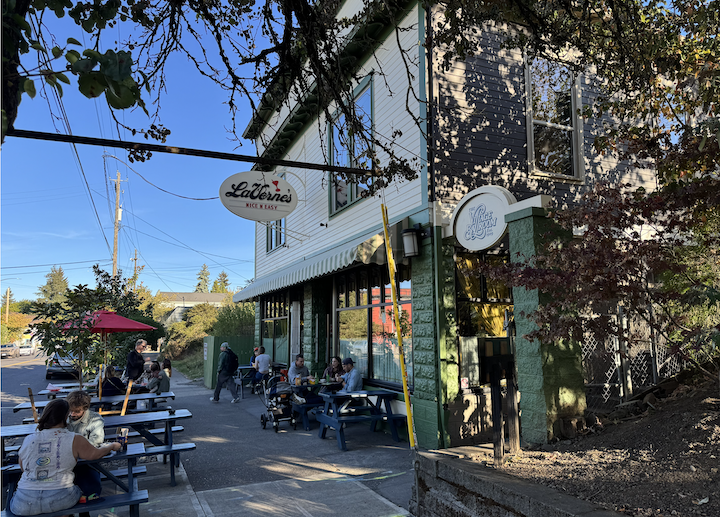
We chose this pub-style place in the Woodlawn neighborhood because it was near our Airbnb and my granddaughter had a dance class a few doors down.
Contrary to popular belief, It doesn’t always rain in Portland. At 5 p.m. on the last day of September, it was a sunny 70 degrees with low humidity and a medium breeze. Bliss. We chose to eat inside at a rustic table in a no-frills dining room that had a small stage with no one performing.
Jojos are often paired with fried chicken, but the LaVerne’s specialty is rotisserie-style, so we ordered (at the counter) a Half Rotisserie Chicken ($27) with an order of jojos ($9). I got a Mexican-style lager of unknown provenance ($8) and Bonnie a red wine ($10).
Appearance
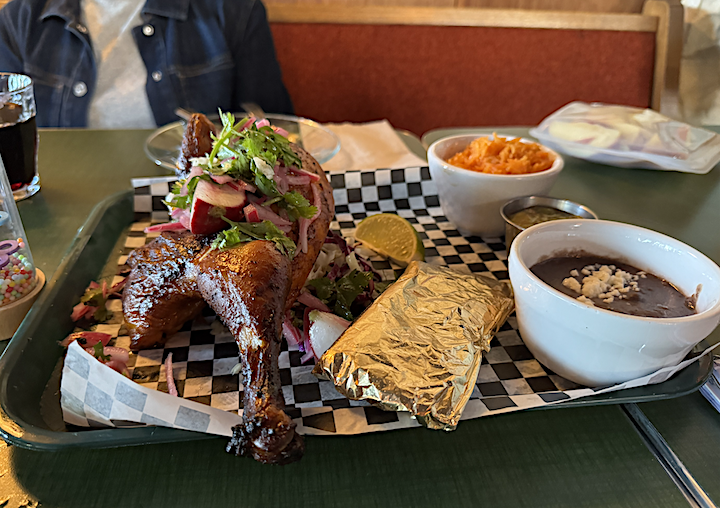
The jojos (lead photo at top) looked nice, but the chicken looked fantastic, with its charred skin and colorful accompaniment of black beans, yellow rice, tortillas and a blend of onions, cilantro and a radish wedge.
Taste and Texture
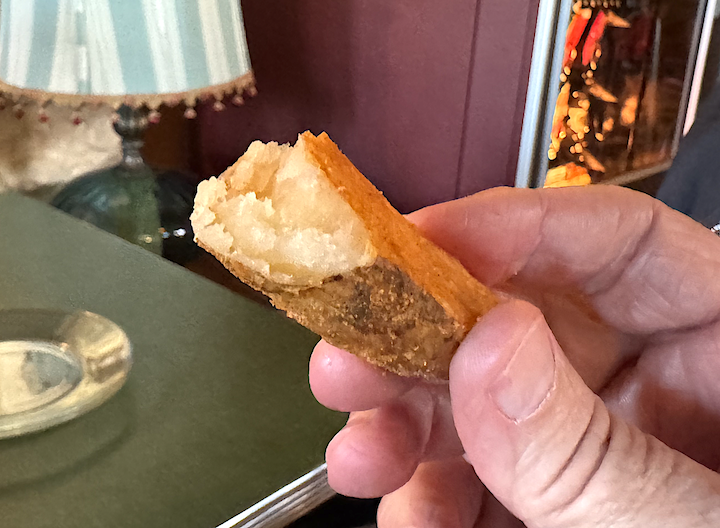
Yes, there is a distinction between a jojo and a conventional fried potato wedge. It’s about what’s inside. These jojos’ innards were fluffy, almost like mashed potato. The deep-fried crust was thin, approaching delicate, another departure from your basic wedge. That’s the texture part. As for flavor, they were not seasoned in any notable way, so delivered essentially a standard potato taste. There were more than enough jojos to go around for our party of five (and-a-half, counting granddaughter) The dish could’ve used a more inventive sauce than ketchup.
The chicken was terrific — seasoned, Latin-style, with achiote spice and ancho, a dried poblano chile. The skin was chewy, not crunchy, and the meat inside was remarkably moist, especially the breast. Bonnie built tacos with the small tortillas. I went with pure bird. The beans and rice didn’t measure up to what you’d get at a decent Cuban place around here, but they were solid.
THREE BIRDS TAVERN
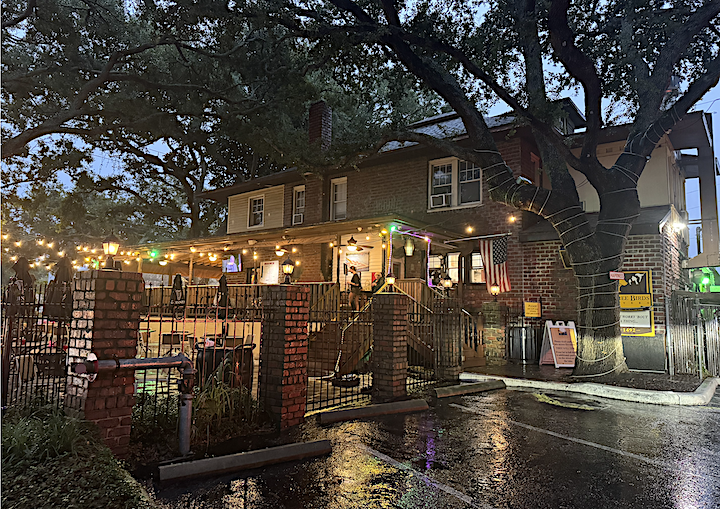
It was still wet and dreary at 7 on Tuesday, but the rain had calmed to a drizzle. Business was, understandly, slow, with a few parties eating on the covered porch. We sat at a four-top in the (empty) pub-style interior. Our server, Glenn — who’d been on the gig for a week — was friendly and attentive. We were his only table during most of our visit.
We ordered the Jojos ($14) from the appetizers list. For matchup purposes, I added a chicken dish: Citrus Chicken ($24). We did not order beer or wine.
Appearance
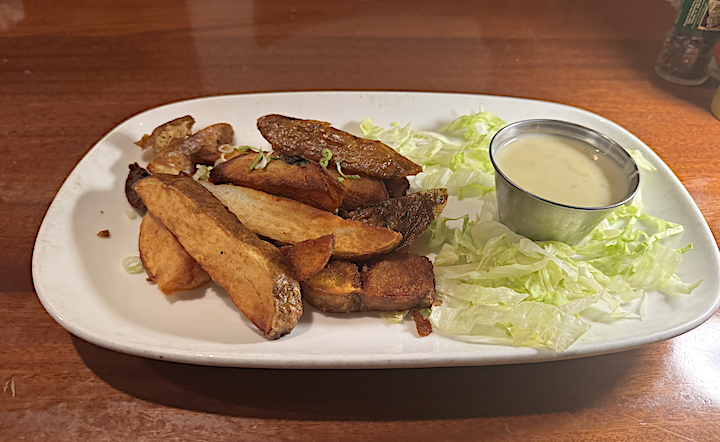
The helping of jojos was noticeably smaller than the one at LaVerne’s. But it came with a jalapeño & cheddar dipping sauce, which was an encouraging sign. The pile of lettuce made no sense, other than to fill out the plate. The Citrus Chicken lacked the visual pizzazz of the bird at LaVerne’s.
Taste and Texture
The innards of these jojos were firm, but not coarse, similar to a baked potato. The crust was marginally crustier than the ones at LaVerne’s. There were a few thin, shriveled ones that stayed on the plate. These jojos had a substantial potato flavor, and the sauce provided some creamy enhancement and a touch of spicy heat. We ate most of them before our entrees arrived.
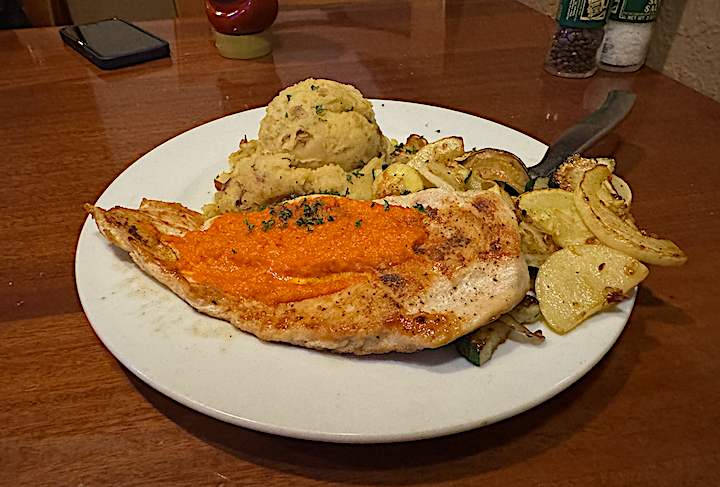
The thin chicken breast was mostly dry, chewy in places. The sauce — a mixture of sundried tomatoes and “citrus butter” — had an unusual flavor, and did little to liven up the chicken. The mashed potatoes and the squash were fine.
And the Winner of the Joust Over Jojos Is …
Three Birds.
Before you accuse me of being a “homer,” let me clarify: I preferred the somewhat coarser insides of the potatoes in the Three Birds version, and the velvety sauce was a major plus. This FFF is about jojos — hence, the winner.
Now … as for the meals overall, I preferred LaVerne’s. And then there’s the matter of value. The jojos at Three Birds cost 55.6% more, and my guess is that there was about half as much. Both tabs ran about 75 bucks, and we didn’t have adult beverages at Three Birds.
So let’s call it a split decision.
This thought occured to me: Would it be grand if all potato wedges were called jojos? So fun to say. And to write: Jojos.
And finally, for those highly discriminating readers who may be wondering how a jojo is different than a regular potato wedge, here is some basic info that I culled from the AI machine. I cannot say if this overview applies to the jojos I had.
• Jojos are typically seasoned and breaded/flour-coated, then deep-fried. Ordinary potato wedges are often just tossed in oil and seasoning. The coating gives jojos a crisp, crunchy exterior surrounding a soft, fluffy potato interior.
• Jojos are usually deep-fried, whereas wedges are commonly baked or roasted (though they can also be fried).
• Jojos tend to be thick, substantial wedges, usually with the skin left on.