


Got That Mojo Workin’ — Cuban Roast Pork + Black Beans and Rice
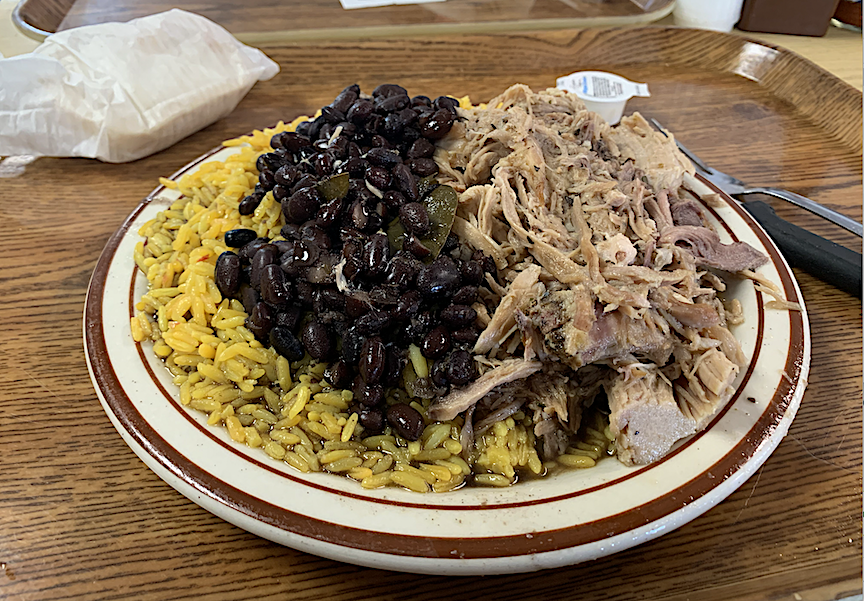
The first time I had black beans and rice was in Ybor City not long after I’d graduated from college in upstate New York. It was a revelation. I had no idea that a pile of beans, whatever their color, could be — I dunno — exciting. That they laid atop a bed of flavorful yellow rice, also new to me, probably had something to do with my infatuation. It wasn’t long before I added Cuban-style roast pork to the regimen. I’d go out of my way to have the combo dish whenever I visited Tampa from my home in St. Pete. This was the late ’70s, when Cuban food was very much a Tampa thing. Over the years, Pinellas has developed a few worthy Cuban restaurants, so for this week’s Food Fight it seemed fitting to pit Tampa vs. St. Pete in a cross-bay battle. I chose two eateries that ranked very high on various online surveys: Pipo’s Restaurant, located on a busy section of Hillsborough Avenue in Town ‘n’ Country, and Bodega in St. Petersburg’s Edge District. BODEGA In the first week of April, I’d ordinarily relish dining al fresco on a sidewalk at 2 p.m. Not Tuesday. Amid a stretch of record-setting high temperatures, we beelined to the indoor dining room after placing our order at the outdoor walkup window. I ordered the Lechon Plato: slow-roasted mojo pork with grilled onions, a side of beans and rice, and maduros (fried sweet plantains). Bodega’s indoor dining room is a strictly no-frills space: a few tables with plastic chairs, unfinished floors and an S-shaped bar with fixed stools. An upbeat server brought our meals out a few seconds after our butts hit the chairs. Appearance A workmanlike presentation: a white plate piled high with the stuff promised on the menu. The rice was white not yellow, the beans looked like they might be starting to congeal, the onions appeared limp and the plantains looked as unappetizing as all the other plantains I’ve seen. But when it comes to this dish, I knew better than to pass judgment based on appearance. Texture and Taste Bodega’s Cuban-style roast pork didn’t have as much mojo working as others I’ve tried. It was short on citrusy tang and could’ve been saltier. The meat was tender and moist, save for a few bites that landed on the dry side. Overall, though, I would’ve liked more zing. Same with the black beans (too soft) and rice — not quite bland, but standard-issue stuff. Sorry to say that there will be no report on the quality of the plantains. I’ve never liked them. But for due diligence’s sake, I took one small bite. Still don’t like ’em. PIPO’S RESTAURANT In the mid-’90s, I had a short-term copywriting job in an office down the street from Pipo’s. A few colleagues and I ate lunch there regularly — sometimes two, three times a week. I don’t recall ordering anything other than roast pork with black beans and yellow rice. And then at a certain point we reached burnout and stopped going. Before I could let my burnout cool and go back for more, I had found another job. I haven’t been back to Pipo’s since, and am very curious to see if the dish casts the same spell as it did nearly 30 years ago. We pulled up at 2:30 on Wednesday to an ugly green building. Bonnie expressed some trepidation, but I told her not to worry. (I hoped I was right.) We grabbed trays and walked down the cafeteria line. The roast pork and the yellow rice laid conveniently next to each other. The enormous helping, which nearly overflowed the plate, cost $6.95. … Six dollars and ninety five cents. Was it 1994 again? We sat at a small table. A terrestrial radio station, commercials and all, came out of tinny speakers. I really could’ve done without Whitesnake’s “Here I Go Again.” Appearance Man, it looked really, really good — just as I remembered. The dish came with a couple slices of Cuban bread, wrapped in white paper — same as decades ago. Texture and Taste Man, it tasted as great as it looked — just as I remembered. Pork marinated to perfection: the citrus was there but not overbearing, spot-on saltiness and a hint of pepper. Every bite was sublimely moist and tender. The beans were just the right level of firm. The rice, it was yellow. And flavorful. You know those times when you keep eating well past sated, just for the taste of it? “One more bite,” I said to Bonnie — three or four times. We still took a decent-sized portion home. And the Winner of the Roast Pork with Black Beans and Rice Contest Is … No contest. Pipo’s. Hey, there was inherently nothing wrong with Bodega’s dish. But it was up against the champ. Pipo’s is all about serving authentic, expertly prepared food in large portions for a ridiculously low price. You don’t go there for the ambience. The restaurant may be in a fatigued building in a drab section of town, but if you find yourself in the area, and you like legit Cuban food, you’d do well to stop in. Let me take this time to thank the management at Registry Tampa Bay for giving me this gig. Without it, I probably never would’ve eaten at Pipo’s again, and got to revel in exquisite food with a side of nostalgia. Appearance
A Tussle Over Two Types of Fish Tacos
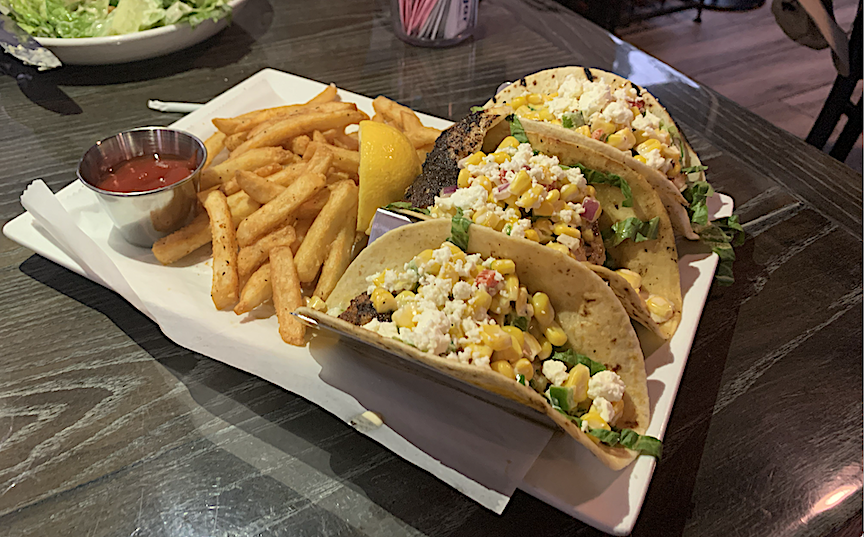
Fish tacos, a staple of Florida’s coastal dining, can be maddeningly inconsistent. When made well, the fish is moist and toothsome; the flavors flow. You pick up the taco up with two hands, tilt your head slightly, and enjoy delicious bite after delicious bite. When botched, the fish is dry, tough, or overly fishy — or all three; fragile tortillas fall apart because they’re over-sauced, causing juice to run down your wrist; and (a personal peeve) they’re covered with a cloying mango salsa that dominates the taste and renders the tacos too sweet. Wanting to avoid the latter scenario, I went with two higher priced restaurants located on the waterfront in downtown St. Pete: Fresco’s Waterfront Bistro at the entrance of the Pier, and Paul’s Landing in the Vinoy. Still, no guarantees. Let’s see. FRESCO’S WATERFRONT BISTRO Situated on the western end of the Pier, Fresco’s offers abundant outdoor seating with views of the boats clustered in St. Pete’s central yacht basin. At 6:30 on Wednesday, though, such vistas required a 45-minute wait. We opted for an indoor table in the corner by a window. The dining room was also full, but to the restaurant’s credit, the ambient noise was not deafening. In fact, it wasn’t even irritating. Bonnie and I waited for about 10 minutes for a server to appear. I approached a female staffer and (politely) told her about it. She replied, cheerfully, “I got ya.” Brian appeared shortly after with apologies that weren’t necessary. I ordered Baja Fish Tacos with blackened grouper ($30). I generally avoid discussions of price in Friday Food Fight, but in this case I admit to some sticker shock. Appearance A trio of ample-sized tacos were lined up in their little stalls, blackened fish peeking out from the toppings. A sensible helping of fries, ketchup and a thick lemon wedge made for an enticing presentation. I briefly lamented that I had to snap photos before digging in. Texture and Taste Let’s start with the grouper: The generous chunks were deftly blackened (not overpoweringly spicy), at once flaky and moist. Flavor-wise, they walked that fine line between bland and fishy. The tortillas — a hybrid of flour and corn — proved an efficient delivery vehicle, hanging together well. The topping was exemplary — a mixture of corn, lettuce, onions and a light amount of sauce that prevented the tacos from turning into an ungodly mess. A smattering of mild feta cheese added smooth texture and a smidgen of piquancy. These flavors blended together elegantly. Kudos to the chef for including corn. I gathered the kernels that fell out and ate them with a fork. The fries were terrific. Their rustic, crispy exteriors gave way to smooth insides with genuine potato taste. I ate them all — or should I say we. Bonnie poached a few, and I had to stop myself from slapping her hand away. PAUL’S LANDING We came in through the Vinoy’s main entrance, then navigated a labyrinth of hallways, stairs and an elevator to reach Paul’s Landing at 2:30. Along our sojourn we passed well-dressed guests and staffers who unfailingly smiled and said hi. The crisp morning had turned toasty when we grabbed a covered two-top on the vast patio. We were treated to lovely views of the St. Pete skyline and yachts in the basin. As we sat down, a special surprise: Miles Davis’s 1961 ballad “I Thought About You” played at a moderate volume on the speakers above us. I ordered Gulf Fish Tacos ($22). Appearance It was hard not to notice that Paul’s Landing’s version had two tacos compared to Fresco’s’ three. They were also a tad smaller. A handful of tortilla chips and a mini-jar of salsa finished out the plate. Texture and Taste Starting with the fish: The blackened chunks of mahi mahi were comfortably moist and tender, but a bit short on flavor. The seasoning offered the slightest hint of spicy heat. Beds of slaw brought welcome crunch, and the chopped tomato and onions added a brightness to the flavor. A smear of avocado puree on top was pretty, but I couldn’t taste it. These tacos hung together well, and only a few drips of sauce fell onto my hand. The chips and salsa were a drab accompaniment. How about offering a choice of one side? And the Winner of Our Fish Taco Tussle Is … Fresco’s. Little surprise there, right? While Paul’s Landing served a worthy fish taco meal, it didn’t approach the size and satisfaction level of Fresco’s. And even though Fresco’s charged $8 more, it ultimately provided better value. Still, thirty bucks for a plate of fish tacos … Times have changed.
Battle of the BLT’S (With a Mystery Ingredient)
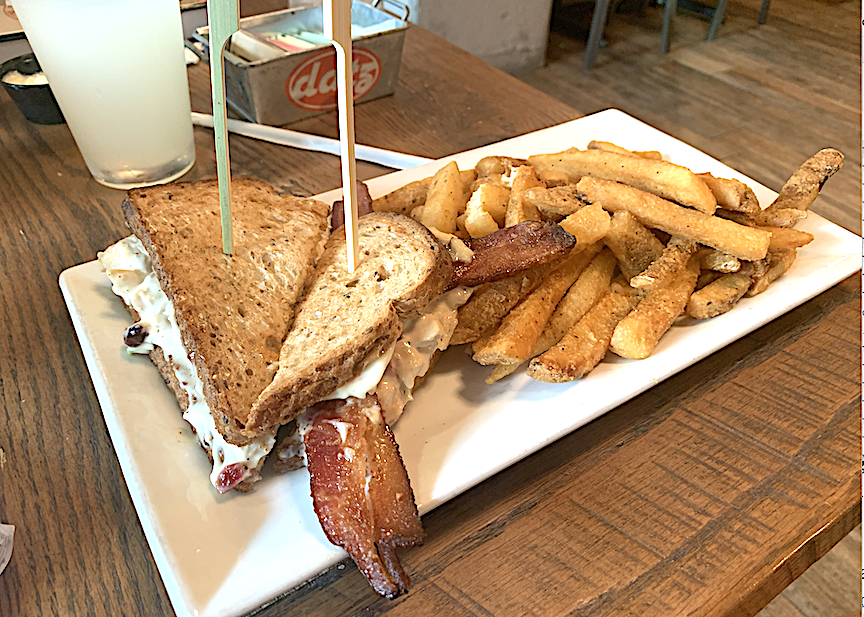
What goes better with bacon, lettuce, tomato, bread and mayonnaise than … chicken salad? I was in the FFF Lab researching restaurants for this week’s edition featuring the iconic BLT, hoping to find a couple of contestants that took a more interesting approach than your usual diner style. Nothing much stood out. As I scrolled and clicked, I came across two places that combine their BLTs with chicken salad. Sounded promising. I dig both. Our Food Fighters are: Chicken Salad Chick and Datz. CHICKEN SALAD CHICK I’ve driven by the location on 4th Street in St. Pete dozens of times, and the name has always furled my brow. Seems like there should be a “The” before “Chicken.” But what do I know? The fast-growing Alabama-based chain is closing in on 250 stores. Chicken Salad Chick’s novel concept offers a dozen different types of chicken salad in the categories of Traditional, Spicy, Savory, and Fruity and Nutty. You choose a scoop (or more) and eat it by itself on a bed of lettuce, with a salad or in a sandwich. I ordered the Chicken Salad BLT ($10.49), with Olivia’s Old South, traditional chicken salad with sweet pickles and egg. (The counter person graciously gave me samples of two flavors to help make my choice.) A side came with it, so I opted for Pasta Salad. Appearance A consummately fast-casual presentation, right down to the plastic fork wrapped in cellophane, pasta salad in a paper cup and two limp-looking dill pickle spears. Texture and Taste The bacon was an afterthought. That’s largely because Chicken Salad Chicken doesn’t do any cooking in-house, so its bacon is pre-cooked and microwaved. The meager strips was crackly and didn’t have much of a bacon taste. I pulled out a small piece to sample. It crumbled like sand in my mouth. The whole wheat-bread was run-of-the-mill. The thick slices of tomato were pretty flavorful. The lettuce was requisitely crisp. Where this sandwich made its bones was the chicken salad (which stands to reason). The chicken itself was minced, not chunky — which is how I like it. The chicken-to-mayo ratio was just right — not wet and messy, but not dry either. The pickles added some down-home sweetness. DATZ Located on Central Avenue downtown, in the same building as the James Museum of Western and Wildlife Art, Datz has a comfy vibe inside, and there’s even a “living room” next to the main dining area. We arrived at 6 on Wednesday and settled at a two-top indoors, next to a window. Bonnie and I had the place all to ourselves. We felt pretty special. The humdrum modern rock on the sound system was a tad too loud, so I asked our server if someone could turn it down a notch or two. He told us no, politely, and explained that the volume is controlled at the “corporate office.” Take from that what you may. I ordered the Birds of a Feather ($16): house-made chicken salad plus the BLT stuff, on “ancient grain bread.” I wondered how old it was — and if it was moldy. With a straight face, I asked our bearded waiter about it, and he quickly deadpanned me back. I sensed that it wasn’t his first time engaging in allegedly clever banter about ancient bread. I got fries on the side. Appearance The glistening slice of bacon jutting out from the bread and beyond the plate’s edge was an encouraging sign. A small piece of cranberry — or was it a grape? — and chunky chicken, not so much. Texture and Taste Datz lists Birds of a Feather under “Handhelds.” This was more like a handful. The chicken salad was over-mayo’d, which resulted in a sandwich with shaky construction. It started to disassemble when I first picked it up. Then I bit into a chewy piece of bacon, tugged slightly, and it fell apart altogether. The thick bacon slices were cooked just right, with nary a hint of crispiness, and the flavors melded together well. But consuming this sandwich was work. One of the expected joys of eating a sandwich is being able to pick it up and nosh without worrying about sticky fingers and gooey stuff dripping into your hand, not to mention having to put it back together repeatedly. A word about the fries: They’re breaded, which served to make them unnecessarily dry, and muted the potato flavor. And the Winner of the Battle of the BLTs + Chicken Salad Is … Datz. A close one. Ultimately, Datz’s sandwich, while an unholy mess, was more legit, mostly due to the juicy, cooked-in-house bacon. Candidly, if I’d have known that Chicken Salad Chick used microwaved bacon, I would have chosen another restaurant. Too late. However — kudos to the Olivia’s Old South chicken salad. I’ll probably return to CSC to give some of the other recipes a try. Hold the bacon.
Putting Bread Pudding to the Test
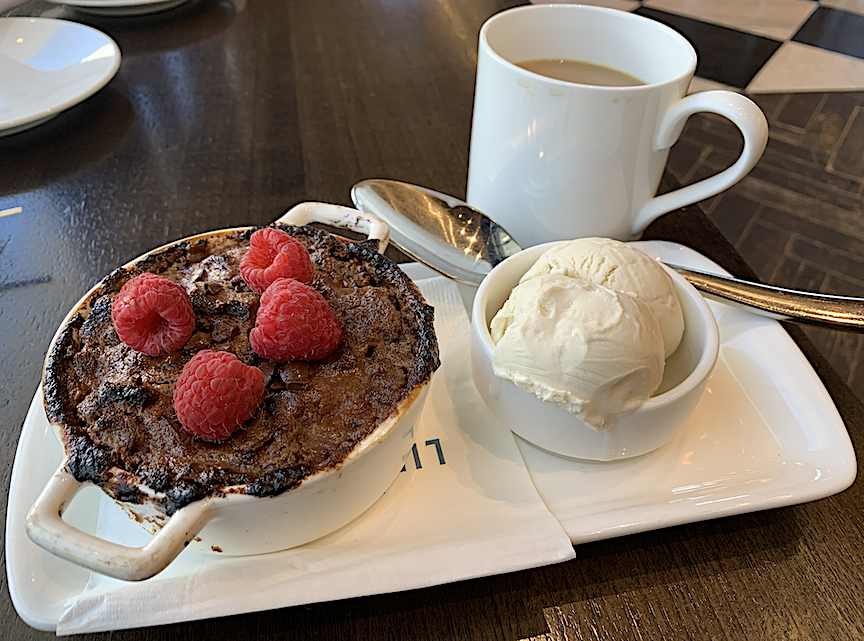
I must’ve been in my late-30s when we pulled the minivan into a Cracker Barrel for lunch during our annual family trip to the Jersey Shore. After finishing the main meal, I perused the menu and saw something called Bread Pudding. Northeastern-raised, I’d never heard of it, even though I’d lived in Florida for nearly two decades. The name didn’t sound very appetizing, but perhaps the menu description did, or the server vouched for it, because I ordered my first bread pudding. Instant love. I don’t remember much detail … Warm. Raisins. Some kind of syrup. Vanilla ice cream, melting. Heaping, messy spoonfuls. Coconut shavings? Maybe not. I don’t often order dessert in restaurants, but when I do, I look for bread pudding (although I don’t always choose it). The dish has gotten fancier over the years, and has incorporated all sorts of ingredients. A classic case of turning peasant food into fine cuisine — or trying to. I chose two restaurants that have bread pudding as a mainstay on their dessert menus: The Library in south St. Petersburg; and Doc Ford’s Rum Bar & Grille on the St. Pete Pier. They have considerably different recipes. THE LIBRARY On delightfully crisp Wednesday, I popped in around 1:30. Bonnie — my partner in life and Food Fights, as well as my driver — was ill and thus sidelined. The restaurant, inspired by Baltimore’s George Peabody Library, is in the same complex as Johns Hopkins All Children’s Hospital. It’s a classy place, with high ceilings, huge windows, lots of blonde wood and, of course, shelves filled with books. Even with a sizable late lunch crowd, the room was not boomy at all. Kudos to the sound designers. The Library has four doors, making for easy ingress/egress. The clientele did not appear to be the type to dine and dash — and, dear reader, please don’t get any ideas, despite me just giving you one. Here at RegistryTampaBay, we discourage criminal activity perpetrated on local restaurants. So yeah, I paid. I ordered Warm Raspberry Bread Pudding ($10) and coffee ($3), and added a side of vanilla ice cream ($2). Appearance I’d not seen bread pudding presented like this before, although it was attractive. A small round crock held a rugged-looking brown substance. The burnt-black edges concerned me, but four plump raspberries on top was a nice touch. Texture and Taste My favorite bread puddings have come as a firm wedge that holds together. This was not that. The Library’s version was rather soupy. The pieces of bread were the size and shape of croutons, and some of my bites were chewy, presumably from the burned parts. The menu description mentioned cinnamon sourdough and raspberry cream. I tasted neither (not to say they weren’t in there). The menu also promised dark chocolate, and on that count it delivered — in spades. With a hint of bitterness, the chocolate hogged the spotlight. The tart raspberries added to the flavor intensity. You know what helped? Vanilla ice cream. It mellowed the boldness, added a creamy quality and made the bites more friendly. I ate it all. DOC FORD’S RUM BAR & GRILLE Thursday, another postcard day, only warmer. At 4 p.m., it was 75 and cloudless. This is our official Spring Break week, so the Pier was hummin’. (Quick side note: this attraction needs more shade.) Doc Ford’s was packed, but not full. The host offered me an outdoor table in direct sun or an indoor table next to a window. I chose the latter. The waterfront place is big and loud and boomy — as expected. I ordered Banana Bread Pudding ($8.95), vanilla ice cream included, and a cup of coffee ($2.95). Appearance Again, Doc Ford’s version looked different than my past bread puddings, but nevertheless enticing. A dark brown mound was hugged by two scoops of the essential ice cream and a small slice of banana. Texture and Taste Whether it was chocolate-infused banana bread or banana-infused chocolate bread, the combination melded together elegantly. I could readily taste both flavors. Using milk chocolate rather than dark made the bites land easily on my palette. The bread pudding itself had a spongelike texture, porous but still firm. The ice cream did its job, and did it better as it got meltier. I’m not crazy about banana desserts, but this slice proved to be a little flavor bonus. Ultimately, Doc Ford’s bread pudding was a successful variation on a classic dessert. And the Winner of Our Putting Bread Pudding to the Taste Test Is … Doc Ford’s. An easy call. Let me add that I really dug The Library’s atmosphere and will go there again for a full meal. If I could’ve brought my Doc Ford’s bread pudding over to The Library, all would have been bliss. And let me also add: As much as I’ve valued my bread pudding journey, nothing has quite compared to that first time at Cracker Barrel. Some years after, I went to the location on 54th Avenue in St. Pete specifically for the bread pudding. It was no longer on the menu. Still isn’t. Sigh. C’mon Barrel, get Crackin’.
Two Italian Restaurants Play a Game of Chicken—Parmigiana
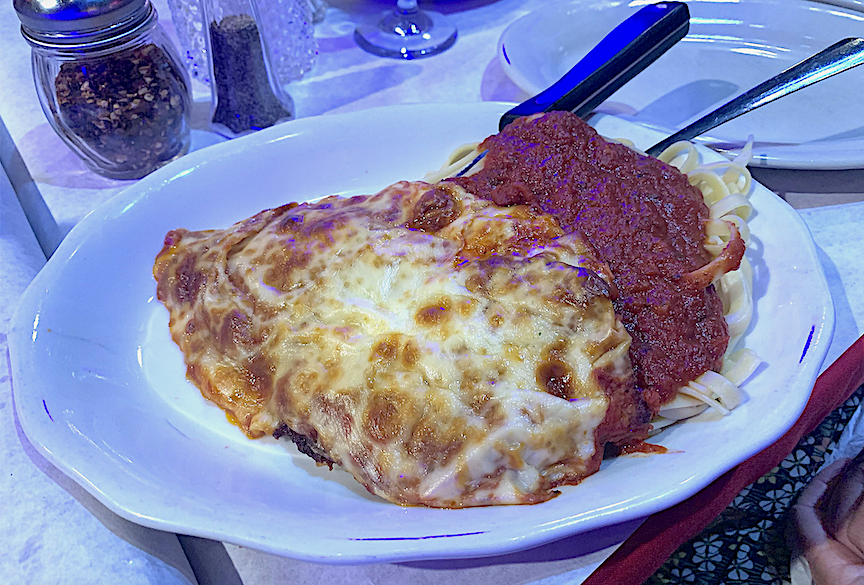
Is there one traditional, affordable Italian restaurant in America that doesn’t have chicken parm on the menu? Doubt it. And that’s a good thing. Can you find me an American adult who’s never had chicken parm? Good luck trying. The dish originated in the Northeast by Italian immigrants and became an Italian-American restaurant staple by the 1950s. When made well, chicken parm is a whole lot of yum. I chose two traditional, affordable Italian restaurants that have been around awhile: Gigi’s, founded in 1967, and Cafe Cibo, which opened in 1999. Both places called their versions “Parmigiana.” So to show the proper respect, we’ll use that. GIGI’S Gigi’s Treasure Island location — there’s also one in St. Pete Beach — has been open since 1970. And it looks it. That’s not to say the place is rundown, just, um, antique. If you like the feel of an old, traditional Italian restaurant, this is your joint. The menu even has a category called Early Bird Specials. The only things missing were red-and-white checked tablecloths and fedora-wearing old-timers sitting in the corner. We had a party of seven on Sunday at 6. The smallish dining room was full, the tables close together. It took longer than we liked for a server to appear. (Someone cracked “if” she showed up instead of “when”. Wait — that was me.) But we couldn’t be too snooty. After all, we had a large group dining at a restaurant on the beach at the height of tourist season. It all got sorted and the drinks (Peroni for me) arrived punctually. Bonnie and I split the Chicken Parmigiana ($22), and I couldn’t resist a Wedge Salad ($12.95). Appearance It’s hard to make Chicken Parmigiana look pretty. So Gigi’s doesn’t try. They simply put a healthy portion on a white plate. The bird was smothered in melted parmesan and the fettuccine covered in red sauce. I don’t like my wedge salads subtle. Bring them slathered in blue cheese dressing and covered in bacon crumbles. This one definitely fit the bill. Texture and Taste When Mom made her legendary chicken parmesan, she pounded on the meat until it was translucent. That’s what I got used to, but as I’ve come to find out, that’s not how restaurants do it. Gigi’s chicken was thinner than most. (Check mark.) This was not fork-cut chicken parm. I used a knife to saw into the shell of cheese, which yielded nice chewy bites when mixed with the chicken and simple red sauce. The fettuccine was fine, perhaps a little softer than I’d hoped. Most white-meat chicken I’ve had in recent years has tended toward dry, even chalky. (Perhaps it’s my more exacting tastebuds.) Gigi’s chicken was on the dry side, but moister than most, and more than moist enough when mixed with the other ingredients. The portion was just right for the two of us. The Wedge was as advertised — crunchy and messy and with so much dressing that we left small pools of it on the plate. CAFE CIBO Cafe Cibo is located on 4th Street North at 87th Avenue in St. Pete. At 6 p.m. Tuesday, we got a table right away on the covered patio. Traffic noise all but drowned out the light instrumental music, which was fine by me. Like we did at Gigi’s, Bonnie and I decided to split the Chicken Parmigiana ($20.75), and were assessed a $5 fee for the privilege. I’m no fan of split charges, but this one turned out to be a value add: Bonnie and I each got to choose our own salad (she the Caesar, me the house), and our own pasta (Bonnie fettuccine, me penne). Appearance The dish included one breast on each of our plates, topped (but not covered) with a thick padding of parmesan. The chicken was thinner than that of Gigi’s (a bonus check mark). The portion was so huge that we couldn’t envision not splitting Cafe Cibo’s Chicken Parmigiana. The salad was no meager side deal, but came in a big bowl. Texture and Taste Let’s start with the salad, a winner. A hefty portion of mixed greens, red onions, cherry tomatoes and black olives was dressed in a house balsamic vinaigrette just as I like it — generous but not soaked. The dressing had just the right ratio of sweetness to tang. The chicken parm was perplexingly inconsistent. Some bites bordered on sublimely juicy and flavorful, but a few near the edge were crackly, almost burnt. The cheese was not well melted either. My penne pasta was firm, if not quite al dente. The marinara sauce carried the day. It was subtly delicious and smooth, not fussy or fancy, elevating the bites of chicken parm, and the pasta too. Two Restaurants Played a Game of Chicken—Parmigiana, and the Winner Is … Cafe Cibo. Not an easy decision. Each place did certain things well, and others not so much. Although I’m a sucker for a wedge salad, Cafe Cibo’s house made the contest a dead heat. Truth be told, I liked each restaurant’s salad better than their chicken parm. What ultimately tilted the decision in Cibo’s favor was its terrific marinara sauce. Another nod to this week’s winner: Cafe Cibo offers a bowl of bread at no charge. I don’t much care to dip pieces in a blend of oil and Italian seasoning, so I usually ask for butter. Cafe Cibo had its own dipping sauce, the likes of which I hadn’t tasted. The orange-hued potion was elegantly seductive, present but not overpowering. I asked the server what was in it. After some pleading on my part, she revealed that it combined tomato sauce with lots of garlic and basil. And butter. Yum.
A Tasty Carpaccio Contest
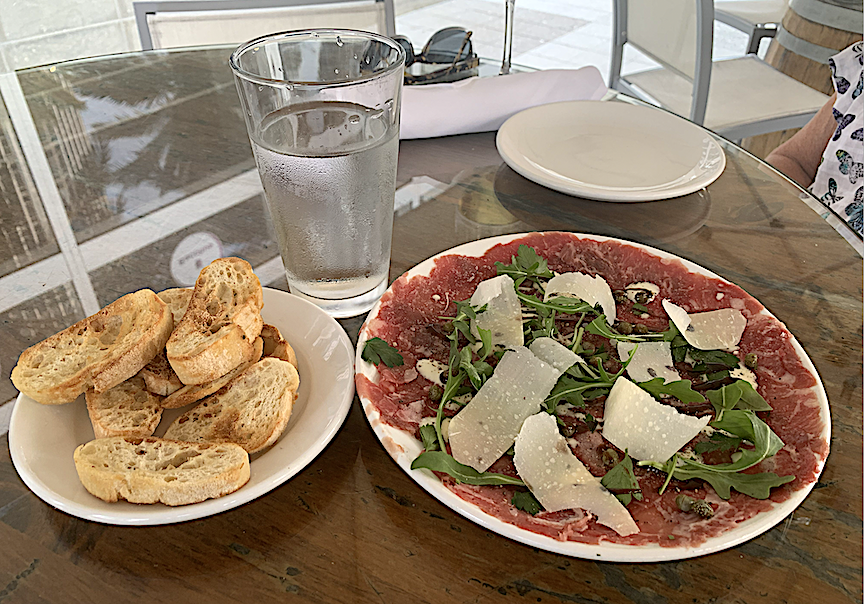
Sorry, Grandma. I’m puttin’ on airs — sittin’ down to a fancy-shmancy dish that consists of … raw beef. It’s nothing like your pot roast. Okay, so Grandma Snider is long deceased and I don’t recall ever apologizing to her in the grave. But I can hear that pinched voice and Ohio accent wondering what on earth I’m doing eating something called Carpaccio. “Look at you, puttin’ on airs.” I generally eat my beef cooked, medium. But many years ago, the South African couple who owned a (long-defunct) restaurant in downtown St Pete urged me and Bonnie to try Carpaccio, despite our resistance to raw beef. We were surprised how much we liked it, and had it several more times. Two years ago, we ordered Carpaccio at a posh restaurant called Slightly North of Broad (S.N.O.B.) in Charleston, S.C., and were so enamored that we wondered if we should order another plate and cancel our entrees. Even though the dish was invented at Harry’s Bar in Venice, Italy in 1963, and named after 15th/16th-Century Venetian painter Vittore Carpaccio, it’s not strictly the province of Italian eateries. I chose two non-Italian places a couple of blocks from each other in downtown St. Pete — Parkshore Grill and Bacchus Wine Bistro — mostly because their menu descriptions looked inviting. PARKSHORE GRILL Parkshore Grill has been located on Beach Drive since before it was, y’know, Beach Drive. The pricey New American place has a lunch menu, but offers its dinner menu — which includes Carpaccio — all day. We sat at one of the Parkshore’s sea of sidewalk tables at 3 p.m. Wednesday. Eighty degrees, sunny with some wispy clouds, and a refreshing breeze. Thinking that downtown would be jammed, we grabbed a parking spot on 4th Ave. N. and hoofed it a half-mile. When we arrived at the restaurant, there was a spot directly across the street on Beach. My creaky knee was mad at me, but all was forgiven when we sat down at a wrought-iron four-top. We ordered “Peppercorn Seared Prime Beef Carpaccio, Shallots, Capers, Truffle Oil, Sea Salt, Parmesan” ($22). Appearance The dish was artfully arrayed on a large white plate. The beef looked nicely marbled, with the peppercorn crust visible on the edges. Compared to my previous Carpaccios, though, there wasn’t a whole lot going on: A dozen-plus thin, silver-dollar-sized slices of raw beef with some garnish. It looked kind of paltry. Definitely an appetizer. Texture and Taste The beef was tender, as expected, and had a hint of spicy heat courtesy of the peppered edges. We gladly scarfed it up. The delicate onion paired well with the meat, but the little wedges of parmesan proved somewhat overbearing. The truffle oil was barely noticeable. My biggest issue with Parkshore’s Carpaccio was the size of the portion. It was more snack than appetizer. BACCHUS WINE BISTRO Bacchus, which has been open four years, is situated a half-block west of Beach Drive on 2nd Ave. NE. The restaurant has outdoor tables, but its sidewalk footprint is not as large or scenic as Parkshore’s. It was 3 p.m. Thursday, an identical postcard day to the previous one. We sat at a high-top table that was too high. The top came up to my chest, which was a mild annoyance. For Bonnie, it was borderline uncomfortable. But we are restaurant troopers, and we soldier on through First World problems. Bacchus’s cuisine is decidedly French. When I used the restroom I heard “My Baby Takes the Morning Train” — sung en français. Cute, but thankfully the restaurant did not have outdoor speakers pouring French tunes onto the sidewalk. Most of the menu items are mid-priced. But not the Carpaccio. The “Wagyu Beef Carpaccio: filet mignon, crispy shallots, parmesan crisp, citrus aioli, balsamic glaze” cost $25. Appearance Crowded onto a smallish white plate, the helping appeared larger than the competition’s. The slices of beef were thinner and not as clearly cut. The dish was topped with hefty shavings of parmesan and plentiful sprigs of arugula. But the most welcome surprise? Toast! Made from slices of a house-made baguette. Texture and Taste The Texas Wagyu beef came apart with the slightest tug of a fork. A good sign. Not such a good sign: My first bite was worrisomely chewy. A good sign: The remainder was not. This beef wasn’t spicy like Parkshore’s, but it had a heartier taste. The balsamic and aioli added moistness and complexity to the flavor. The ideal bite was to pile the beef, cheese, sauces and arugula on a small piece of toast, which was crunchy but not tough or dry. These two-biters were agreeably sloppy. This Carpaccio was pretty substantial. It was all we ordered, and we didn’t leave hungry. And the Winner of Our Carpaccio Contest Is … Bacchus. Its version had more going on, all of it good, and there was more of it. The toast tilted my decision even further. I plan on recruiting some fellow restaurant troopers for an al fresco happy hour, which Bacchus runs daily from 3-6 p.m. You should too.
A Spirited Diversion Into Cocktails—The Manhattan Project
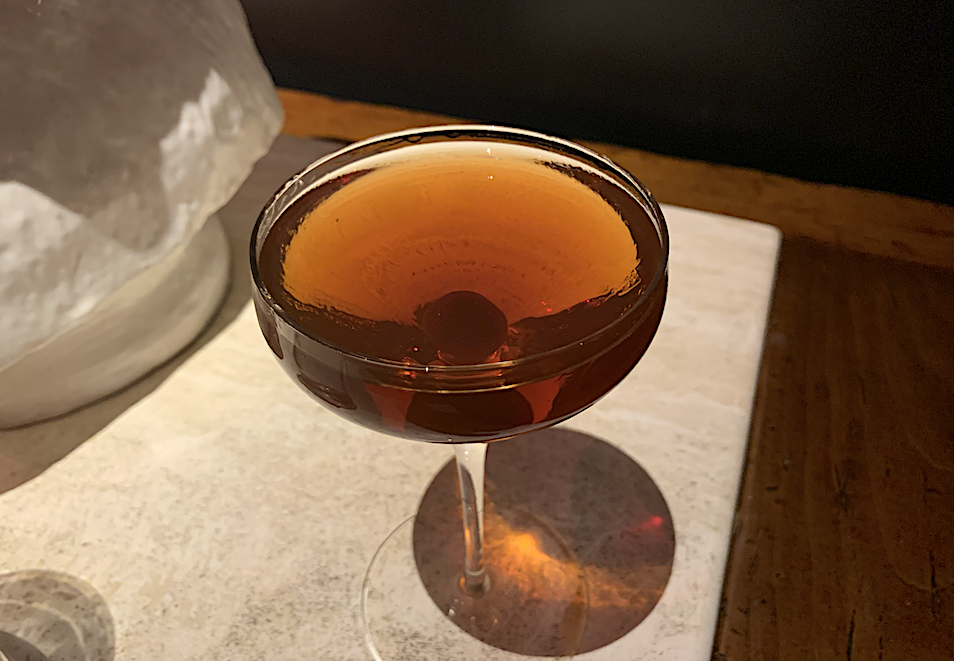
Belly up to the bar for the first ever Friday Cocktail Fight. The Registry Tampa Bay brass suggested a momentary pivot into the world of alcohol, and I was glad to oblige. So how does a committed Bud Light drinker select a cocktail for a debut of this magnitude? Throw a dart. Okay, not entirely. My one basic criteria: I didn’t want to choose a specialty (aka frou-frou) cocktail, but rather one that had some history and gravitas. The Manhattan certainly fits the bill. According to popular history, the drink dates back to the Manhattan Club in New York City in the mid-1870s. It’s properly made with two ounces of rye or bourbon, and one ounce of sweet vermouth, along with bitters, finished off with a preserved cherry. But as I found out from two expert mixologists, it’s far more involved than that. I’ve had maybe three Manhattans in my lifetime. So for this foray, I enlisted help from my longtime friend Brendan, a sophisticated, cultured and erudite — not to mention handsome — fellow who ages ago was a bartender and still relishes mixing drinks at home for friends (or, in my case, having Bud Lights in the fridge). Let’s call him my spirits guide. I wanted to make my Manhattan project a mini-bar-hop, so chose two establishments within walking distance in downtown Tampa: Hotel Bar and CW’s Gin Joint (which is also a restaurant). I dressed up — a little. Not full Don Draper, but my slacks had creases. CW’s GIN JOINT We arrived shortly after 5 on Tuesday — it was still light out — and a uniformed man swept open the door with a subtle elan. Of all the gin joints in all the world … I find one with doorman. We immediately encountered a long bar, where the four of us (Bonnie and Brendan’s wife Sandy joined in the fun) chose to sit, rather than at a nearby table. The space was dark — but not so much that your eyes had to adjust — illuminated by elaborate chandeliers. The barstools, outfitted with backs, were eminently comfortable. Preparation and Presentation I explained my mission to our bartender Jonathan, asking him, vaguely, what he suggested in terms of a Manhattan. “What kind of food do you like?” he asked. After a slightly confused pause, I said, “A lot of things … Um, meatloaf …” Jonathan explained that my food preference would help determine the type of Manhattan I would enjoy, especially in terms of how spicy he made it. After a brief discussion, he mixed up two in one pitcher. Here’s where it got complicated. Brendan and Jonathan fell into a discussion about the finer points of different vermouths. I furiously took notes. I’ll spare you the mixology play-by-play, but Brendan signed off that Jonathan had covered all necessary steps. After assessing my flavor profile, our mixologist decided to use a 50/50 blend of Michter’s rye and bourbon (both of which cost about $45 a bottle). He concocted the customized elixir and gave it a vigorous stir (for a desired dilution), while delicate cocktail glasses sat nearby, chilling with ice in them. Brendan approved. Texture and Taste Very dissimilar to Bud Light. I could see the small Luxardo cherry (in lieu of the more pedestrian Maraschino) lolling on the bottom of the louche brown liquid. I carefully brought the glass to my lips and took a small sip. This Manhattan ($14) was more spirits-forward and less sweet than the ones I remembered. It had an appealing bite to it, without ever crossing over into harsh. I leisurely drank it to the bottom amid stimulating conversation. I left the cherry. HOTEL BAR It was dark when we walked the five blocks south to Hotel Bar, which is not located in a hotel and does not have a doorman. The place is smaller, more casual, with unfinished concrete floors. We settled into a section of the bar that accommodated the four of us. The stools were comfy. The massive spirits wall came equipped with a slide-able ladder for bartenders to reach the tippity-top shelf. We would not be anywhere close to that rarified air. My Manhattan excursion revealed a surprising takeaway: Even the best cocktail lounges do not use high-end liquor for this particular cocktail. The highfalutin-ness would get buried in the mix. We decided to order one Manhattan ($12) and have Brendan guest sip. Preparation and Presentation Our bartender, Juan, didn’t ask me what type of food I like, but instead explained, “we’re a classic cocktail bar, so our recipes are pretty standard.” He used Rittenhouse 100-proof Rye (about $20 a bottle), which he characterized as “really spicy.” Juan allowed that you can make a Manhattan with bourbon, but disapproved, explaining that the liquor’s sweetness does not blend as well with the sweet vermouth. Hotel Bar uses a house mixture of two vermouths — one heavier, one lighter. Brendan and Juan fell into a discussion about bitters. I furiously took notes. Texture and Taste As you can see from the above photo, Hotel Bar’s Manhattan looked virtually identical to the Gin Joint’s. As it should be. Wait — the cocktail glass may have been a millimeter or two deeper. Despite Juan’s assertion that spicy should balance out sweet, this Manhattan was notably sweeter than the one at Gin Joint. It was in no way cloying, though, and went down smoothly. I drank it leisurely, leaving the cherry at the bottom. And the Winner of the First Ever Friday Cocktail Fight: Manhattan Project Is … Em, I can’t pick one — not an outright victor, at least. More so than Friday Food Fights, this one really boils down to preference. Here’s the decision: I preferred the Gin Joint’s more bracing version. Brendan gave the nod to Hotel Bar’s sweeter take. We’ll call it a draw. Ultimately, the four of us were the winners. We enjoyed a terrific time out with friends. Bonnie and I hadn’t drunk at
A Fancy French Toast Taste-Off

By Eric Snider Another Friday, another dish I don’t often eat. That’s one of the things I like about this gig: It all but forces me to broaden my culinary horizons. Falafel, chicken wings, jambalaya, Tandoori chicken — all recent Food Fight contestants, and all stuff that I wouldn’t ordinarily order in a restaurant or sit down to at home. Which brings us to French toast, another dish that’s a very occasional thing for me — although, I have to say, folks who eat it frequently should probably walk around hooked up to a heart monitor. We decided to conduct our French toast test in one outing. Wednesday morning was perfect: cloudless skies, 70 degrees, a mild breeze. We didn’t want to do diner French toast, but instead were looking for something more — ahem — elevated. So after perusing menus online, we hit Cassis in downtown St. Pete, after which we went directly to First Watch on 4th Street North. (The chain, which has restaurants in 29 states, has been headquartered in Bradenton since 1986.) We knew we’d be sharing the plates, but we also knew we were in for a plentitude of French toast, and would have to be careful not to turn our FFF field work into something we regretted for the remainder of a gorgeous day. CASSIS Located on Beach Drive just west of the Pier in the heart of downtown’s high rent district, Cassis has an enormous footprint, seating more than 300, indoors and outdoors. We arrived at 10 a.m., and during our visit the capacious, classy interior had two diners, while nearly all of the outside tables were occupied. We sat at a covered four-top and chatted as folks strolled by on Beach Drive. Cassis serves brunch from 10 to 3. We ordered Brioche French Toast, with honey mascarpone, bananas and strawberries, and a cup of coffee each. Appearance We were pleased to see that the portion was sensible, not monstrous. The whole affair was sprinkled with powdered sugar. The maple syrup came in a cute little jar. Texture and Taste Lovely and decadent, as French toast should be. The brioche bread could’ve used a longer soak — it wasn’t exactly dry, just not as moist as I’d hoped. The syrup readily solved the issue. The strawberries, perfectly ripe, added a welcome tartness when blended with the sweet stuff. The banana chunks, which I had to slice in half, didn’t add much, and many of them got left on the plate. Kudos to the honey mascarpone, for its velvety smoothness. My best bites combined toast, strawberry, and a dollop of the soft cheese, liberally coated with syrup. Very rich, but worth the indulgence. FIRST WATCH We sat at a two-top on the patio, which overlooks a busy stretch of 4th Street. At about 11:15, the traffic was heavy, creating a constant hum, except when some knucklehead with visions of NASCAR grandeur decided to roar down the thoroughfare, or someone nonsensically honked their horn, or an ambulance activated its siren. Don’t these people know we’re trying to enjoy our late breakfast? But hey, the weather was gorgeous. We ordered Blackberry Lemon Cream French Toast and, on a whim, I asked for a glass of milk. I know for a fact that milk goes well with French Toast. Appearance Placing the French toast in a shallow bowl was a nice touch. It was readily apparent that you had to like blackberries. I like blackberries. I don’t love blackberries. Texture and Taste This French toast was ambitious, a complex blend of flavors and textures, very blackberry-forward. Add in the mixed-berry compote on the bottom of the bowl, and the maple syrup was rendered all but moot. The challah bread was lusciously moist and the lemon curd added moments of puckery surprise. The milk proved to be an ideal complement. And the Winner of the French Toast Taste-Off Is … Cassis. This was a close call, and it was refreshing to have a close call after a series of mismatches. I ultimately preferred the comparative simplicity of the Cassis version. I admired First Watch really going for something unique, and enjoyed my meal, but in the end it was a bit too much of too many good things. Let me add that Bonnie, my partner in life and Food Fighting, much preferred the First Watch version. That’s all well and good, but please note that my decision is official and final.
Chicken Wings (Part 1) — Two Chains
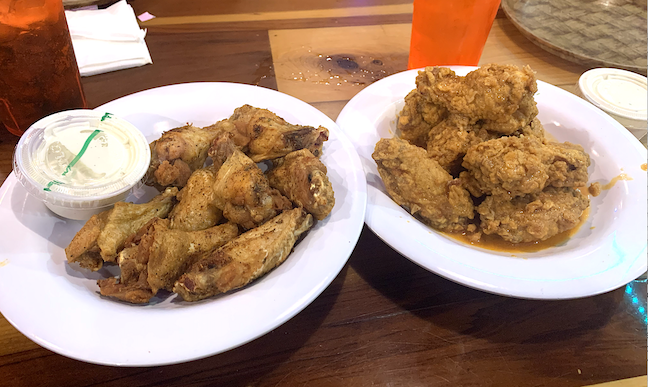
By Eric Snider I’m not a wings man. Still, I’ve had lots, mostly with the fellas in a sports bar after league basketball games. I’d pull them from a big pile and munch while quaffing pitcher beer. I barely tasted them, but recall not caring for their texture. Those days are long since gone. To my knowledge, I’ve never ordered chicken wings in a restaurant. But they’re so ubiquitous that sooner or later they had to make it into Friday Food Fight. And what better time than Super Bowl weekend. No less an authority than Al Roker declared on Wednesday’s Today Show: “It wouldn’t be a Super Bowl without wings.” Who am I to argue? I’m splitting our chicken-wings competition into two parts: This one features two high-profile chains with long histories as wing meccas. Hooters is a must. It was founded 40 years ago in Clearwater with wings as its marquee dish. Buffalo Wild Wings dates back to 1982 in Columbus, Ohio. There are five locations in the Tampa Bay area. At a later date, I’ll feature two local restaurants. HOOTERS We chose the location on 4th Street in St. Pete, and arrived about 7 p.m. It had been a very long while since I’d set foot in a Hooters. A Lightning game was on and the play-by-play blared over the sound system. Very annoying. It was nigh impossible to have a conversation while hyper-excited hockey announcers called the game. The place wasn’t packed, and there was no watch party going on, so why crank up the play-by-play throughout the entire space? (That said, I’m not a Hooters regular, so what do I know?) In other matters, the all-female waitstaff wore the same skimpy, clingy outfits that I recalled from decades ago. Our server was polite and efficient. We ordered eight Original Style, mild, and eight Naked, blackened (both $12.09), plus Curly French Fries ($4.29). An order of ranch and blue cheese dressing cost $.99 each. (Really?) APPEARANCE The Original Style sat in a pool of oily-looking sauce, just like Buffalo-style wings are supposed to, but not appealing to these eyes. They were jumbo-sized, made even larger when breaded and sauced. The Naked ones looked more appetizing. Some of the Curly Fries were as perfect as little Shirley Temple’s ringlets. TEXTURE AND TASTE A surprise: The Original Style morsels were better than the Naked. The Originals nicely blended the Buffalo sauce into the breading, which made each bite balanced with sauce, crust and chicken. The meat was substantial and fall-off-the-bone, the sauce itself surprisingly subtle. The Nakeds came up short on the blackened seasoning, and bordered on bland. They were rated Medium on the menu’s heat scale, but were pretty mild. Dipping them in blue cheese dressing helped. The fries came out late — but better late than never. They were piping hot, moist and, best of all, potato-y. BUFFALO WILD WINGS We chose the BWW on a busy stretch of Park Boulevard just west of US 19 amid a cluster of chain restaurants. It was Wednesday at 2 p.m., during a lull. The large room had high ceilings and wall-to-wall TVs that shared space with an eclectic tableau of sports memorabilia. Tame classic rock (Journey, of course) and pop played over the sound system at moderate volume. We sat in a comfy booth. I ordered a combo platter ($23.49) that included six signature wings, mild, and six boneless (they didn’t have naked on the menu), with a lemon pepper rub, plus fries and coleslaw. The blue cheese dressing didn’t cost extra. APPEARANCE At first glance, it was a tidy presentation, neatly arrayed on a tray. Closer inspection, though, revealed some potential problems. The traditional wings lay in a pool of sauce that looked too thick and too orange. The boneless were not so much rubbed as heavily dusted with a granular mixture. If I saw that stuff on my dining room table, I’d reach for the hand-vac. Texture and Taste BWW takes a different approach than Hooters. According to our (conventionally clad) server, the restaurant cooks its wings, then tosses them in whatever sauce or rub the customer selects. That made eating the traditional wings a sloppy mess. And unlike Hooters, BWW did not have a roll of paper towels on the table. Too much sauce — sauce that had an extremely potent flavor that eclipsed the chicken itself. Now to the lemon-pepper boneless ones: Wow, what an assault on the tastebuds, and not in a good way. Extremely salty, with the lemon adding a harsh tartness, and the pepper only confusing matters more. Mostly, though, it was was the texture — like eating pieces chicken covered in flavored sand. I tried wiping some of it off, which helped a little, but quit after two or three. The fries were basic, and quickly became cold. And the Winner of the Two Chains Wings Taste-off Is … Hooters. This was more of a mismatch than I anticipated. I simply didn’t care for BWW’s cooking-then-coating approach. And I enjoyed my meal at Hooters, although it didn’t turn me into a wings man. A quick postscript: When our BWW server asked how everything was, I gave her a polite but honest assessment of the boneless wings, telling her that I couldn’t eat them, and why. She asked me if there was anything she could do. I thanked her, and said it wasn’t necessary. Before we left, she handed us a bag. Inside was a small box filled with lemon-pepper bone-in wings. Credit for good customer service. When I opened the container at home, I saw that the wings had been more lightly dusted. I ate one. It was better — somewhat. I’ll leave it at that. Oops, almost forgot: Go Eagles!
A Falafel Kerfuffle
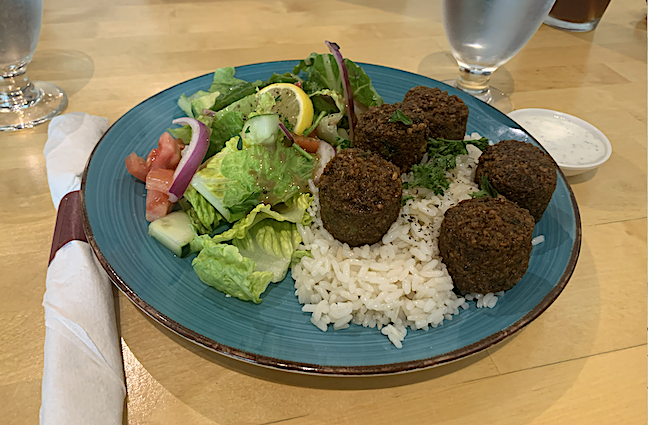
Eastern Mediterranean foods are not only good for you, they’re fun to say out loud. And that makes them fun to order. Tabouleh. Mezze. Kebab. Couscous. Baklava. Tzatziki. And the ultimate: Babaganoush. I try to say Babaganoush a few times a week, for no reason other than it makes me smile. Try it yourself. Falafel belongs on the fun-to-say list, too. And that’s one (small) reason I chose to feature the chickpea-based fritters on this week’s Friday Food Fight. That, and they’re meatless and healthful and delicious. Well, not always delicious. Sometimes they taste like bark from a 100-year-old oak tree. I chose two Mediterranean restaurants in St. Pete for our showdown: Mio’s Grill & Cafe near Sundial downtown; and Cedars Grill, just west of Kenneth City. MIO’S GRILL & CAFE This small eatery tucked into a stretch of storefronts is owned and run by Chef Bora Caliskan, a native of Istanbul who’s been in the States 11 years and founded Cafe Mio in 2019. Bora told us that he and and he alone mans the kitchen, and that includes washing dishes. The restaurant’s small interior is basic and comfortable, with a few Turkish-inspired touches and tchotchkes. We arrived just after 1 p.m. on Tuesday, and had a seat in a booth. Our server, a gracious fellow who didn’t say much (could’ve been a language barrier), wore all black accented by colorfully patterned suspenders. It worked. Appearance The attractive platter ($17.95) had smallish pieces of falafel arrayed on a bed of rice, next to a Mediterranean-style salad. One aspect set off little alarm bells: The falafel was a dark, dark brown, browner than most versions I’ve seen. Could that mean that eating it would be like gnawing on hockey pucks? It took some fork force to split one in two, and I was pleased to see that the innards were vibrant green. Another encouraging sign: It didn’t crumble. Texture and Taste These fritters had the ideal balance of hearty crust on the outside and moist mash on the inside. When dipped in the smooth, restrained tzatziki sauce, the bites offered contrasting textures — crackly-meets-smooth, crispy-meets-moist — that tantalized my mouth. As falafel goes, the Mio’s version was mild and light. Not overly spiced, so the chickpea flavor really shone through. The moistness was due in large part to the inclusion of imported Turkish olive oil, Chef Bora said, as he showed us the small bottle. The full-bodied rice provided a nice accompaniment. The salad was a tad disappointing. While the dressing was fine, the onions were on the bitter side and the tomatoes were mushy. (I pause here to acknowledge that it’s almost impossible to find a good tomato around here.) Bonnie and I split the dish, and as we walked back to our car I said, “How ’bout that? We just ate a healthy vegan lunch. I’m no longer hungry but I’m definitely not stuffed.” It felt like a win. She agreed. CEDARS GRILL A whole bunch of online reviews rave about this place, calling it a hidden gem. I like a good discovery, especially when it comes to ethnic food, so we ventured west on 54th Avenue and found Cedars just past the Kenneth City border. It was located in a dilapidated strip mall along a stretch of dilapidated strip malls. The restaurant’s vinyl sign that hung above the entrance was faded and flat-out tattered in places. But we forged on, clinging to the notion that you can find really good food in dilapidated strip malls. When we entered the boxy, bland interior around 2:30 on Thursday, nobody was there. “Well, we’re already here,” I said to Bonnie, halfheartedly, and she shrugged, halfheartedly. We sat at a table and waited for a few minutes until finally I walked into the back and caught the attention of a woman. She emerged, gave us menus and summarily disappeared into the back. It was apparent she spoke virtually no English, so no chit-chat. When she returned a few minutes later, we ordered a Falafel Plate ($8.49), a Fatoush Salad ($6.99) and Basmati Rice ($4.99), doing our best to mimic the meal we had at Mio’s. Appearance The four pieces of falafel were joined by tomatoes, onions and thin slices of dill pickle (the owners are Lebanese, so maybe it’s a Lebanese thing). A small bowl of thick Tahini sauce sat in the middle. The array looked appetizing enough. The salad — a mixture of chopped lettuce, tomatoes and green peppers — was covered in thin, dark chips, which turned out to be fried pita bread. The seasoned rice came in a separate bowl. Texture and Taste I fork-split a piece of falafel and it revealed a rich, green interior. I dipped a piece into the sauce and took a bite. Sorry, nope. The exterior crust didn’t have enough crunch. The chickpea mash inside was mushy. The gooey Tahini didn’t help. The taste — I can’t adequately explain in words its unpleasantness, other than to say it was something like smokey, or even burnt (although the falafel was not, in fact, burnt). Putting it objectively as possible, this falafel was not for me. I slowly ate two of the four pieces — including a slice of pickle helped — and retired. (For the record: Bonnie took a couple of bites and found it okay.) The salad was serviceable, although the pita chips were too predominant and the sweet-ish pomegranate dressing was overly thick. The seasoned rice was decent. And the Winner of Falafel Kerfuffle Is … Mio’s Grill & Cafe. [Insert your own “duh,” “really?” “no kidding” what have you.] This wasn’t by unanimous decision, but first-round knockout. And it’s not only because Cedars was such a disappointment, but because Mio’s’ meal was really good, and the falafel was some of the best I’ve had. In hindsight, choosing Cedars was a bad idea. And staying rather than leaving was probably a worse idea. We won’t be dining in shabby restaurants in
A Jambalaya Jam—Two Very Different Takes on a Louisiana Staple
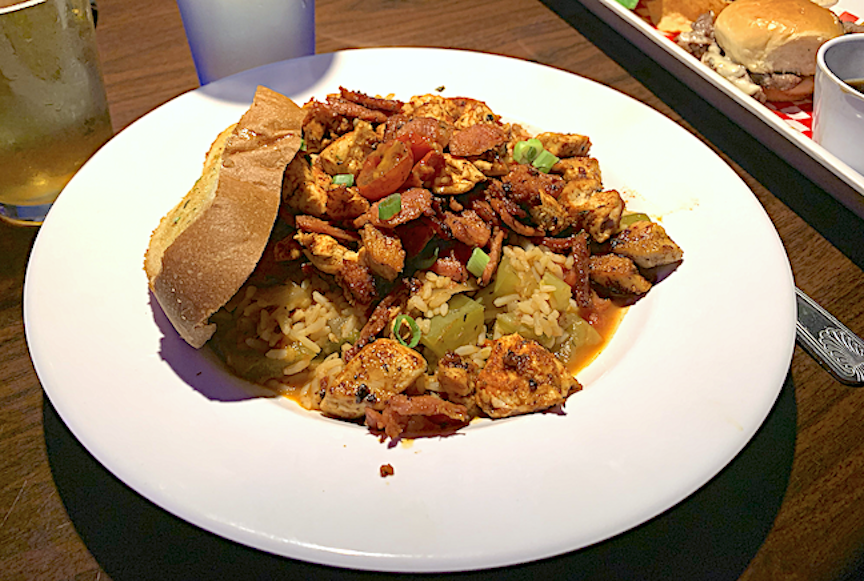
I have limited choices when it comes to Cajun/Creole food. It boils down to jambalaya and red beans and rice. Why? Shrimp. About 10 years ago, I had a sudden realization that I didn’t like to eat those ugly little critters, cold or hot. And heaven knows there’s a lot of shrimp in Louisiana dishes. So for this Friday Food Fight, I flipped a coin and it came up jambalaya. If memory serves, the first jambalaya I ever had was at a restaurant in New Orleans while I was covering the New Orleans Jazz & Heritage Festival in the 1980s. I loved the stuff, but it set the bar pretty high — considerably higher than I’ve experienced since. But I persevere, sitting down to jambalaya (and/or red beans and rice) at local restaurants now and then. To be accurate, Creole jambalaya often includes shrimp, but it doesn’t at Chief’s Creole Cafe, which is located in the Midtown section of St. Petersburg. And, despite its name, Shrimpy’s Waterfront on St. Pete Beach does not put shrimp in its jambalaya. In both restaurants you can add shrimp to your jambalaya for an upcharge. Hey, I saved Registry Tampa Bay a few bucks. CHIEF’S CREOLE CAFE Chief’s, which opened in 2014, sits on the corner of 9th Avenue and 22nd Street South, a thoroughfare once known as “The Deuces,” a thriving hub of Black commerce, entertainment and culture during segregation. The construction of I-275 in the early ’70s effectively sliced the neighborhood in half, leading to its downfall. On Tuesday just after 5 p.m., the corner looked fatigued, with storefront churches, bodegas and barbershops generating no foot traffic. Chief’s, with it’s pink exterior paint and image of Louis Armstrong on the north-facing wall, and charming courtyard on the south side, was like a beacon. We were the only customers (probably in a while) on a cloudy afternoon, with closing time set at 6. And still, Rhonda, who was dressed for the kitchen but acted as our server, gave us a warm, effusive greeting. We chose to eat in the NOLA-styled courtyard on a wrought-iron table for two. Rhonda scurried to bring our drinks, all the while making chit-chat. She placed a complimentary order of fried okra and a big bottle of Louisiana Hot Sauce on the table. This lagniappe got us off to a tasty start. Appearance Unlike any other jambalaya ($16) I’ve seen. Because Chief’s isn’t doing proper table service at this time, the food came in a plastic container with a cover that I had to pry off, along with a small plastic spoon. I don’t know the ins and outs of Creole vs. Cajun-style et al, but this jambalaya was very clearly a soup, with the rice hidden on the bottom and pieces of andouille sausage peeking out. The top of the container was heavily rimmed with spices. Texture and Taste Probably because it came encased in plastic, this jambalaya was simply too hot to eat for several minutes. I gingerly took some small bites, waiting for it to cool enough to comfortably consume. Using such a small spoon made for some slow eating. I didn’t mind. The dark broth combined with large chunks of andouille, occasional pieces of chicken, rice and vegetables cooked down to puree. It had a potent flavor with plenty of spicy heat that lingered in my mouth — but not so hot that it made me want to tap out. This recipe was clearly not tamed for mainstream tastes. How much this jambalaya veered from authentic Creole/New Orleans convention, I cannot say. I will say that I enjoyed it up to a point, and admired the uniqueness of the Chief’s approach. All that said, I prefer my jambalaya to be more stew than soup. Our visit to Chief’s was a unique dining experience from a restaurant doing its best to get by. Rhonda treated us like VIPs the entire time we were there. We left feeling warm-bellied and warmhearted. SHRIMPY’S WATERFRONT Shrimpy’s is located on the far north end of St. Pete Beach, it’s unassuming entrance down a corridor in a typical beachy strip mall. When we walked through the door on Thursday around 6, it opened to a large indoor dining area. A separate, larger room overlooked the narrow Blind Pass waterway, across from Treasure Island. Because it was a chilly night, the plastic flaps were down and there was no water view. We chose to eat in the dining room. The place was busy. Service was brisk and efficient. Our server asked if I’d like to add shrimp ($8) or scallops ($10). “No,” I replied emphatically, albeit with a smile, then added, “thank you.” Appearance Every bit the stew-style jambalaya ($17) I’m accustomed to. It was preceded by a side salad with a tasty ginger-based dressing. The main course arrived quickly, a bit too quickly. I hadn’t finished my small salad. Large chunks of blackened chicken and andouille sausage nestled with hefty slices of green pepper, onion and celery. A piece of toast joined the party. Nicely presented, the dish looked altogether appetizing. Texture and Taste This jambalaya tasted like it looked — a hearty mixture of ingredients that, by and large, worked together well. The big pieces of vegetable were especially welcome. But the chicken and sausage proved too dominant. Plainly put, there was too much of both. The meat smothered the rice and veggies. And some of the chicken was on the dry side. I wished the dish was more rice-forward. Whereas Chief’s jambalaya was too soupy, Shrimpy’s version was wanting of a bit more broth. The dish also could’ve used some more spice, too. It wasn’t bland, exactly, but lacked a certain punch. I inhaled it. I was hungry, and this jambalaya went down easy. And the Winner of the Jambalaya Jam Is … Shrimpy’s. While the waterside restaurant’s version provided little in the way of creativity or challenge, its familiarity proved more satisfying than the competition’s. Chief’s soup-style
A Tandoori Chicken Taste-Off
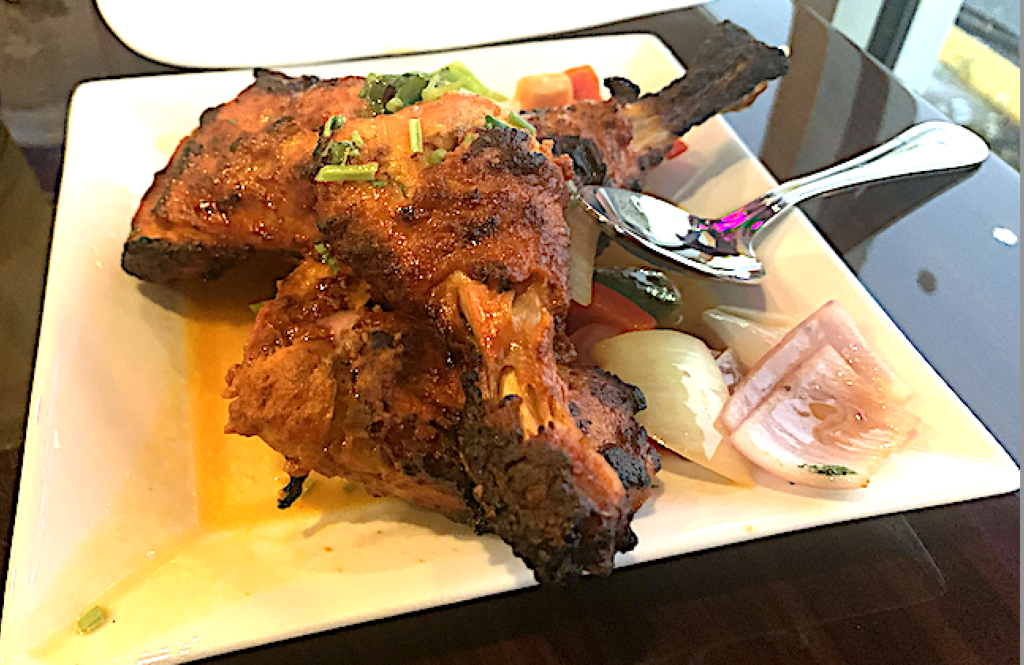
For the first time in the storied history of Friday Food Fight — all 16 months of it — we feature Indian food. The South Asian cuisine can no longer be considered exotic, for most of us at least. But I think it’s fair to say that around here it has not yet become a standard mode of dining. So for India’s FFF debut, I wanted to choose a familiar dish — and that turned out to be Tandoori chicken. For the uninitiated, Tandoori chicken is marinated in yogurt and spices, then roasted in a tandoor, a cylindrical clay oven (according to the cuisine bible, Wikipedia). The dish’s distinguishing feature is its orange color with streaks of black char. I’ve had Tandoori chicken numerous times, and it has ranged from succulently delicious to something akin to jerky (usually as part of a buffet). (Side note: I don’t do buffets anymore; it’s a pandemic thing.) For this FFF, I chose two restaurants that tout their Tandoori chops: Flames Indian Cuisine on MacDill Avenue in South Tampa; and Gateway to India in the Bay Pines area of St. Pete. As accompaniments, we ordered Basmati rice (with no upcharge at either restaurant), Garlic Naan and a Mango Lassi, a traditional, yogurt-based drink that has the consistency of a milkshake. FLAMES INDIAN CUISINE Flames is located in a small commercial section of Palma Ceia neighborhood, across South MacDill from Datz and Dough. The interior, with its brown floor, ceiling and tables and dark green walls, gave the restaurant an almost dour ambience as the sun set at 6 o’clock on Tuesday. But atmosphere was low on our list of priorities. As we waited (a tad too long) for our meals to come out, the lone server — a petite woman whose name I didn’t get because she was too busy — must’ve handed eight or 10 takeout bags to customers, as well as covering a few tables. I nursed the Mango Lassi as we waited. Appearance The first sign that Flames takes Tandoori seriously is that the chicken ($15) consisted of two thigh/leg quarters (rather than puny, mall-chicken thighs or, worse, a breast). This gave me confidence that the meat would likely be tender and juicy. It had that characteristic orange hue with black sections, and was seductively aromatic. The bird was accompanied by lightly grilled onions and peppers, which would turn out to add nice contrasting flavor and crunch. After placing the chicken on an extra plate and adding the rice and naan, I was salivating. (Side note #2: Snapping and checking a bunch of photos before eating is one of the burdensome aspects of this gig. Ahh, the woe.) Texture and Taste Let’s do this chronologically: The Mango Lassi ($6) was sweet, as the server promised, but not as sweet as I like. The drink had a velvety texture but was a bit too yogurt-forward, with the mango taking a backseat. (Side note #3: My favorite sweet Lassi is at Cafe Masala in St. Pete.) The Basmati rice was fine, but lacked the subtle spice found in the best versions I’ve had. The chicken tasted like it looked, which is to say: tender and juicy. I regret to say that I’m incapable of providing an adequate description of what Tandoori tastes like. Savory with a hint of sweetness and ample saltiness? That’s lame. I give up. I checked online and found that Tandoori recipes can include a laundry list of spices that I’ll not list here. Suffice to say that the chicken tasted really good, bordering on really, really good. When it comes to chicken quarters, I’m very limited with a knife and fork — who isn’t? — so I quickly reverted to using my hands, which the Internet tells me is the traditional Indian way. I’m not a gnaw-it-to-the-bone guy, but enjoyed the chicken enough that I didn’t leave much behind. I’ll spare you a photo of the remains. The Garlic Naan ($4) was probably the most impressive part of the meal. Thin, soft (I’ve had it close to crispy) and agreeably chewy, it found a lovely balance of garlic, butter and bread flavors. Very likely the best I’ve ever had. GATEWAY TO INDIA We arrived at 5 p.m. on Tuesday, just as Gateway to India’s doors opened for dinner service. Unlike Flames, this restaurant works hard to evoke the homeland, with ornate chandeliers, colorful drapes, faux flowers, Indian art on the walls, Bollywood ensemble dances on TVs, and other touches. Indian pop played over the sound system at a comfortable volume. Some might regard all this as gaudy. I like to think of it as fun. Gateway had a much homier feel than its Tampa counterpart. The service was friendly and attentive. Three people saw to our needs, including the owner. I ordered a half Tandoori chicken ($13.99). Appearance Much different than the competition’s. Rather than two chicken quarters, this version came as eight distinct pieces of dark-meat chicken, smothered in orange-tinted onions. (The owner explained that the reason Tandoori chicken generally does not use breasts is that the spices don’t adequately sink into the meat.) The Basmati rice was more finely granulated than that of Flames — and here I thought all Basmati rice came in one size. The chicken legs were petite, almost drummette-like, and black on the outside. The thighs were small. In all, the meal did not look as appetizing as its counterpart from across the bay. Texture and Taste Chronologically: The Mango Lassi ($5.99) was sweeter, thinner, smoother, more mango-flavored (and colored) than Flames’ version. And came in a glass rather than a plastic cup. It was the superior drink, by far. I’d stop in Gateway again just to have another. My first bite of the chicken was from a cute little leg piece. Uh oh, jerky alert. This was dry, chewy stuff, with a tough exterior skin. The eating did get better, though. The small pieces made for easier hand-to-mouth consumption (kind of